
Trauma Therapy Lehigh Acres: What to Expect From Your First Sessions

- Trauma Therapy Lehigh Acres: What to Expect From Your First Sessions
- Common Fears Before Starting Trauma Therapy
- How Trauma Therapy Is Different From Regular Talk Therapy
- What Happens in the First Sessions
- A Gentle Next Step
- Healing Is Not a Straight Line
- Finding Trauma Support in Lehigh Acres and Southwest Florida
- Frequently Asked Questions
- Take the First Step at Your Own Pace
If you are reading this, some part of you may be wondering whether it is time to talk to someone. Maybe something happened that still feels close, even years later. Maybe you cannot name it, but your body seems to be carrying something heavy.
First, you are not alone, and wanting support is not a weakness. It is a brave and sensible step. This guide explains what trauma therapy Lehigh Acres residents can expect in the first sessions, so the unknown feels a little less scary.
Common Fears Before Starting Trauma Therapy
Almost everyone who considers trauma therapy has worries. Naming them out loud can make them smaller. Here are some we hear most often:
- “Will I have to relive everything that happened?”
- “What if I fall apart in the session?”
- “Is what I went through even bad enough to deserve help?”
- “What if it takes forever, or I do not get better?”
- “Will I be judged?”
These questions are all valid. Let’s go through them one at a time.
You do not have to relive every detail
This is the fear we hear most, so let’s say it plainly: you do not need to retell every painful moment for therapy to work. A good trauma therapist does not push you to share more than you are ready to share.
Many people are surprised to learn that healing can happen without describing the hardest parts in detail. You stay in charge of what you say and when you say it.
Your trauma does not have to be “bad enough”
Many people minimize their pain. You may think, “Others had it worse,” or “I should be over this by now.” But pain is not a competition.
If an experience, or a series of experiences, still affects your sleep, your mood, your relationships, or your sense of safety, it deserves care. You do not need a certain kind of story to ask for help.
How Trauma Therapy Is Different From Regular Talk Therapy
Talk therapy can be a wonderful way to understand your thoughts, feelings, and patterns. Trauma therapy includes that, and it also pays close attention to the body and the nervous system.
When something overwhelming happens, the brain’s alarm system can go into high gear. Sometimes, afterward, the memory does not get filed away the way ordinary memories do. It can feel “stuck,” so a sound, a smell, or a date can bring back strong reactions as if the danger were happening now.
That is not a flaw in you. It is a protective system doing its job a little too well. Trauma-informed therapy helps your mind and body learn that the danger has passed.
Evidence-based approaches
Yeney Ruiz, LCSW-QS, uses evidence-based approaches, including EMDR and cognitive-behavioral techniques. If you have been searching for EMDR therapy Florida providers, you may want to know what that means in simple terms.
- EMDR (Eye Movement Desensitization and Reprocessing): a structured approach that helps the brain reprocess distressing memories so they feel less overwhelming. It does not require you to talk through every detail.
- Cognitive-behavioral techniques: practical tools for noticing unhelpful thought patterns and gently shifting how you respond to them.
- Nervous system regulation: skills that help your body settle, so you can feel safer in your daily life.
Not every approach is right for every person. Your therapist will talk with you about what fits you best.
What Happens in the First Sessions
Every person’s path is different, but the early sessions usually focus on getting to know you and helping you feel safe. They are not about diving into the hardest memories.
Getting to know you
In the beginning, you can expect a conversation about what brought you in, what you hope will change, and what is going well in your life. Your strengths matter just as much as your struggles.
You can ask questions at any time. You can also say “I am not ready to talk about that yet,” and that answer will be respected.
Building stabilization tools first
Before any work on difficult memories, Vicney focuses on stabilization. That means building a personal “emotional toolkit” of skills for calming your body, grounding yourself in the present, and handling strong feelings when they arise.
This step protects you from feeling overwhelmed or re-traumatized. It also gives you something solid to lean on between sessions. [VERIFY: how many sessions the stabilization phase typically lasts, or remove this note]
Working at your pace
Processing memories only begins when you and your therapist agree you are ready. If it feels like too much, you can slow down or pause. There is no schedule you have to keep up with.
If you want to learn more about how a safe space supports healing, you can read our post on creating a safe environment for healing. For a broader look at how care can stay centered on the person, see A Human-Centered Approach to Trauma Recovery.
A Gentle Next Step
If you have been carrying this for a long time, you do not have to keep carrying it alone. A first conversation is simply a chance to see whether this feels like the right fit for you.
Schedule a Consultation whenever you feel ready, even if you still have questions.
Healing Is Not a Straight Line
Some days you may feel lighter and more hopeful. Other days, old feelings may return. That does not mean you are failing or starting over.
Healing usually moves in waves, with steps forward and moments of rest. There is no deadline and no “right” speed. Going slowly is not a setback; it is often what makes change last.
Hope and the brain’s ability to change
The brain has a remarkable ability called neuroplasticity, which means it can form new connections throughout life. This is part of why many people find that, with support, their reactions to painful memories can change over time.
We cannot promise a specific outcome, because every person is different. But there is real reason for hope. Many people find that life can feel safer, steadier, and more open after trauma therapy.
At Vicney, we sometimes think of the monarch butterfly, which changes form slowly and in its own time. Healing can be like that: gradual, natural, and entirely yours.
Finding Trauma Support in Lehigh Acres and Southwest Florida
Vicney Mental Health is a psychotherapy practice in Lehigh Acres, serving people across Lee County and nearby communities such as Fort Myers and Cape Coral. If you are searching for a PTSD therapist in Southwest Florida or a trauma therapist near you, here is some helpful context.
Yeney Ruiz, LCSW-QS, founded the practice and has more than 10 years of clinical experience focused on trauma and PTSD. She also designs programs for armed forces members, veterans, and healthcare workers. You can learn more about her background on the About page.
If you are looking for PTSD treatment in Lee County, you can also see the full range of support on the Specialties page. Online sessions are available, which can be a comfortable option if travel or privacy is a concern. You can read more in our post on online therapy in Lehigh Acres.
Frequently Asked Questions
Do I have to talk about the worst parts of my trauma?
No. You decide what you share and when. Early sessions focus on safety and building coping tools, and many approaches, including EMDR, do not require you to describe every detail.
How do I know if I need trauma therapy?
If past experiences still affect your sleep, mood, relationships, or sense of safety, it may help to talk with a professional. You do not need a specific diagnosis or a “serious enough” story to reach out.
Is EMDR therapy available in Florida through Vicney?
Yes. Vicney uses evidence-based approaches, including EMDR and cognitive-behavioral techniques. Your therapist will talk with you about whether EMDR is a good fit for you.
Can I attend sessions online?
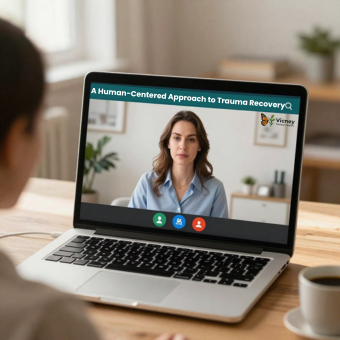
Yes. Vicney only offers online (virtual) therapy sessions.
Take the First Step at Your Own Pace
Reaching out is often the hardest part, and you have already done something meaningful by learning more. When you feel ready, we would be honored to walk alongside you. Schedule a Consultation and take the next step in your own time.
About the author: Yeney Ruiz, LCSW-QS, is the founder and therapist at Vicney Mental Health in Lehigh Acres, Florida.
This article is for general information and does not replace an individual assessment by a licensed mental health professional. If you are in crisis in the U.S., you can call or text 988 (Suicide & Crisis Lifeline), or call 911 in an emergency.